Cracked Shells and Deep Grooves: Why Some Carts Take Longer
Shell condition decides how much cleaning power reaches the dirt. Here is why Galaxis 16 ridges, cracked shells and PAL variants slow a cartridge down.
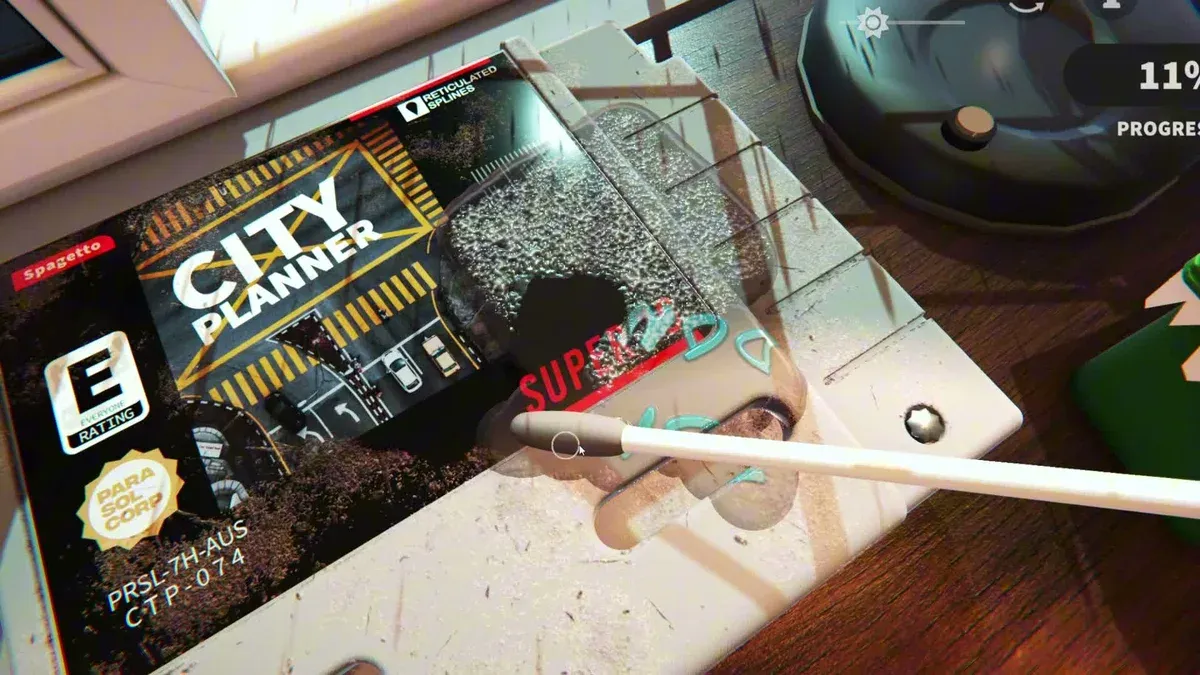
Why does the same amount of dirt take twice as long on some carts?
Because the shell decides how much of the tool touches the dirt. A flat face gives the swab full contact; a moulded ridge gives it a line it cannot press into. Same grime, different reach, different time.
That is geometry, not a difficulty setting. The game does not make some carts dirtier; it makes some carts harder to reach.
Which shells are the slow ones?
The ones with deep moulding and narrow channels.
| Shell type | What slows it down |
|---|---|
| Galaxis 16 | Deep grooves along the body and around the label window; this is the shell the toothbrush exists for |
| PAL variants | Ridge profiles that a flat tool cannot press into |
| Cracked or split shells | Dirt trapped in the break, where no tool sits flat |
| Discs in cases | The opposite problem — quick to clean, and a fast sale |
Disc-based games are the fastest clean in the game for the obvious reason: a flat readable surface and nothing to dig out. If you need money in a hurry, a disc cart is a shorter job than a grooved one.
Why do PAL and NTSC differ in cleaning time?
The region changes the shell mould, not just the sticker. One Epic cartridge was retuned from PAL to NTSC during the demo because PAL shell ridges were hard to get into with that build’s tool strength — the shape was blocking the tool, not the dirt being tougher.
So the region line on the result screen is not purely a collection label. It is a hint about how the cartridge will handle: PAL shells can resist a flat tool in a way the NTSC version of the same title does not, and the same game in two regions is two different jobs.
Can a cracked shell be cleaned?
Partly. A crack or a scuff is condition, not grime — cleaning does not repair it, and the finish screen will still show the layer bars filling while the shell stays scarred. What makes cracks annoying is where they trap dirt: the inside edges of a split are hard to reach and often hold a thin line of grime that keeps the dirt bar off full.
Two things help: the toothbrush, because bristles reach into a split that a swab cannot, and the UV torch, because a crack that looks clean will show exactly where the dirt is sitting.
Do shell colours matter?
Two separate things are happening. Condition traits — cracked, scuffed, drawn on, adhesive residue — are separate from the shell’s material, and the store description names gold shells (or better) as a rarity signal. Notice them before you start work near the label edge, because the interesting carts are the ones worth a careful finish rather than a fast one.
That is also the reason to check the shell before picking a tool: a gold cartridge with deep grooves and a torn sticker is a longer job than its size suggests, and knowing that up front stops you rushing the label.
What actually makes these carts faster?
Tool power, and tool power comes from the shelf. Tools inherit cleaning power, surface area and dirt capacity from the games you display, and stacking the same genre physically enlarges the swab and brush head — a visible difference against the basic starting set.
So the answer to a slow Galaxis 16 is not a better technique. It is a better shelf: rarity and shelf bonuses explains the stacking rules, collection room shows the panel that reports the result, and cleaning tools covers which tool suits which shell. If a specific cartridge is stuck rather than slow, start with Toro the Cat 2.
Related Articles
guides
Autocomplete Not Working at 99 Percent in Cozy Game Restoration
Autocomplete fires only when every layer passes 99 percent, so one bar at 98 keeps the cartridge open. How to find the layer that is holding it back.
guides
Adhesive Not Spawning on Discs: Cozy Game Restoration Bug
Disc cartridges could refuse to spawn sticker adhesive, leaving the ink bar unfillable. Fixed in Patch 1 and live again since 7 November.
guides
Packing Peanuts and the Bin in Cozy Game Restoration
The bin eats peanuts and stickers, peanuts are worth a little money, and the tweezers keep grabbing them by accident. What the desk clutter is for.
Was this helpful?
Thanks for the feedback!