How to Make Money and When to Sell Games in Cozy Game Restoration
What raises a cartridge sale value, why a better grade pays more than a fast finish, and when keeping a game on the shelf beats selling it.
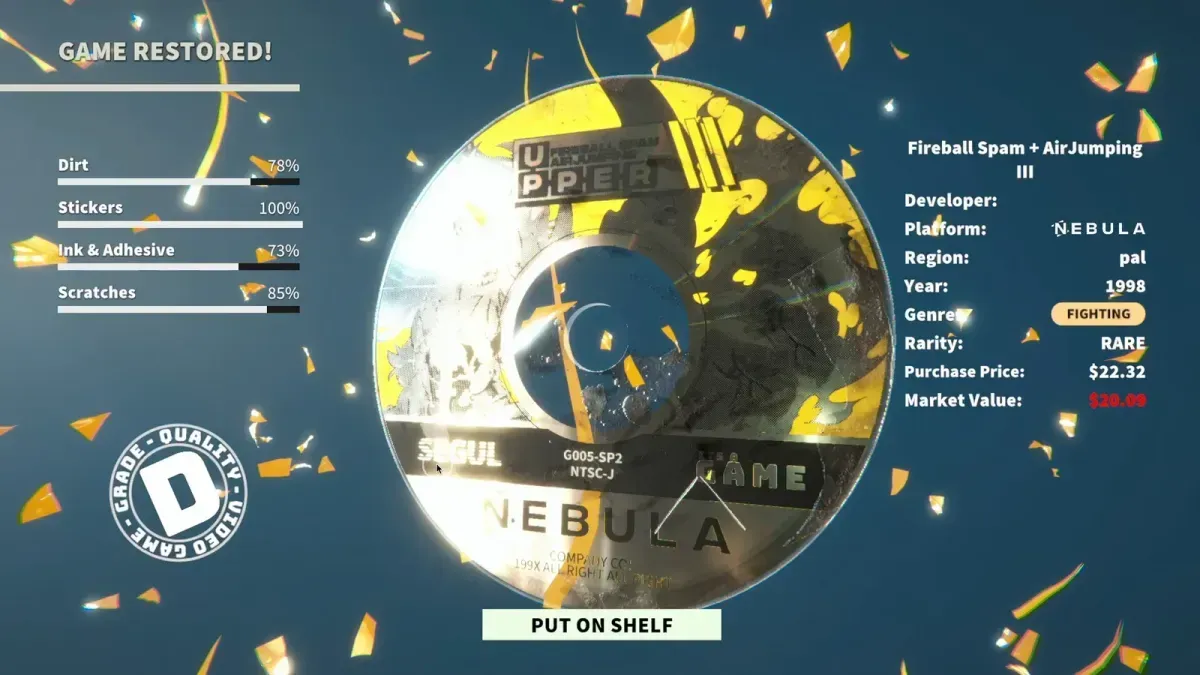
Where does money come from?
Buying a parcel, cleaning what is inside, and selling the result for more than the box cost. That is the loop, and it is the only loop — there is no shop to run and no separate income minigame.
Everything else is optimisation: which parcel to buy, how far to clean, which finished carts to sell and which to shelve.
What actually raises a sale price?
Four things, and only one of them is under your control at the moment of sale.
| Factor | Effect | Can you change it? |
|---|---|---|
| Cleaning grade | Higher grade, higher price; 100% is the top grade | Yes, by cleaning further |
| Rarity | Rarer carts are worth more | No, rolled at open |
| Day market | Which genres and platforms are in demand shifts daily | Only by waiting a day |
| Condition | Shell and label condition feed the grade | Partly, through cleaning |
The practical read: clean high-rarity carts properly, take a fast finish on low-value ones, and if a cart is only worth selling on a good day, hold it in the inventory and sell when the market turns.
Is it worth pushing for a better grade?
Sometimes. The price reads the grade, and the grade comes off the four layer bars, so the last stretch on a Legendary moves real money while the same effort on a Regular barely registers.
The calculation is minutes against margin. On a grooved Galaxis 16 shell the last stretch can take longer than the first pass, because what is left is sitting in the channels — scratches and polish and shell damage and grooves cover why those final marks are expensive.
Should I sell or shelve?
Shelve anything that fills a gap in your collection, sell anything that does not.
- Shelve: new genres, platforms you have not covered, high rarities, duplicates that match a genre stack you are building. All of these raise the room’s bonuses and improve tomorrow’s parcels.
- Sell: duplicates of titles you already display, low-grade Regulars in a genre you have stacked, and carts on a platform the room already covers well.
Selling your whole shelf to fund one upgrade is the version of this that hurts: you lose the bonuses, tomorrow’s delivery gets worse, and the upgrade arrives with nothing to work with. The mechanism behind that is on rarity and shelf bonuses.
Does the market really change daily?
Yes. Which genres and platforms are in demand shifts from day to day, and the delivery forecast moves with it, so a cart that is worth holding one day is worth selling the next. That is the reason the sell screen is worth a glance before you dump a batch.
The cheapest version of this habit: finish a session by reviewing the inventory, not by selling as you go. Two carts sold on the right day can fund a parcel that two sold on the wrong day cannot.
Weather sits on top of the daily market rather than replacing it — it touches the economy and the perks attached to parcels, and it is a separate system from the shelf. Weather and what it changes separates the two.
What should the money go into?
Two permanent buys matter early: more parcels per day, and more shelf space. Neither is a tool — tools get stronger through the shelf rather than through a shop, which is why the room doubles as the economy engine.
The order matters early. Shelf space first, because it raises the bonuses that make every future clean faster and every delivery better; parcel slots second, because a wider choice is only useful once you can afford the boxes and clean them in a day. The trade is laid out on upgrades and unlocks.
How do I avoid running dry?
Keep a buffer. Parcel prices are not fixed, the good boxes cost more, and an empty account on a day with a strong delivery is the worst position in the game. If you have to choose between one more parcel today and cash for tomorrow, take the cash.
The room is the long-term answer to this problem: a well-built shelf raises the value of what you sell as well as the quality of what arrives, which is why collection room is an economy page as much as a decorating one.
Related Articles
guides
Autocomplete Not Working at 99 Percent in Cozy Game Restoration
Autocomplete fires only when every layer passes 99 percent, so one bar at 98 keeps the cartridge open. How to find the layer that is holding it back.
guides
How to Change the Language in Cozy Game Restoration
The game picks a language on first boot and the gear icon reopens the list. The full set, plus why Russian was missing and when it returned.
guides
Packing Peanuts and the Bin in Cozy Game Restoration
The bin eats peanuts and stickers, peanuts are worth a little money, and the tweezers keep grabbing them by accident. What the desk clutter is for.
Was this helpful?
Thanks for the feedback!